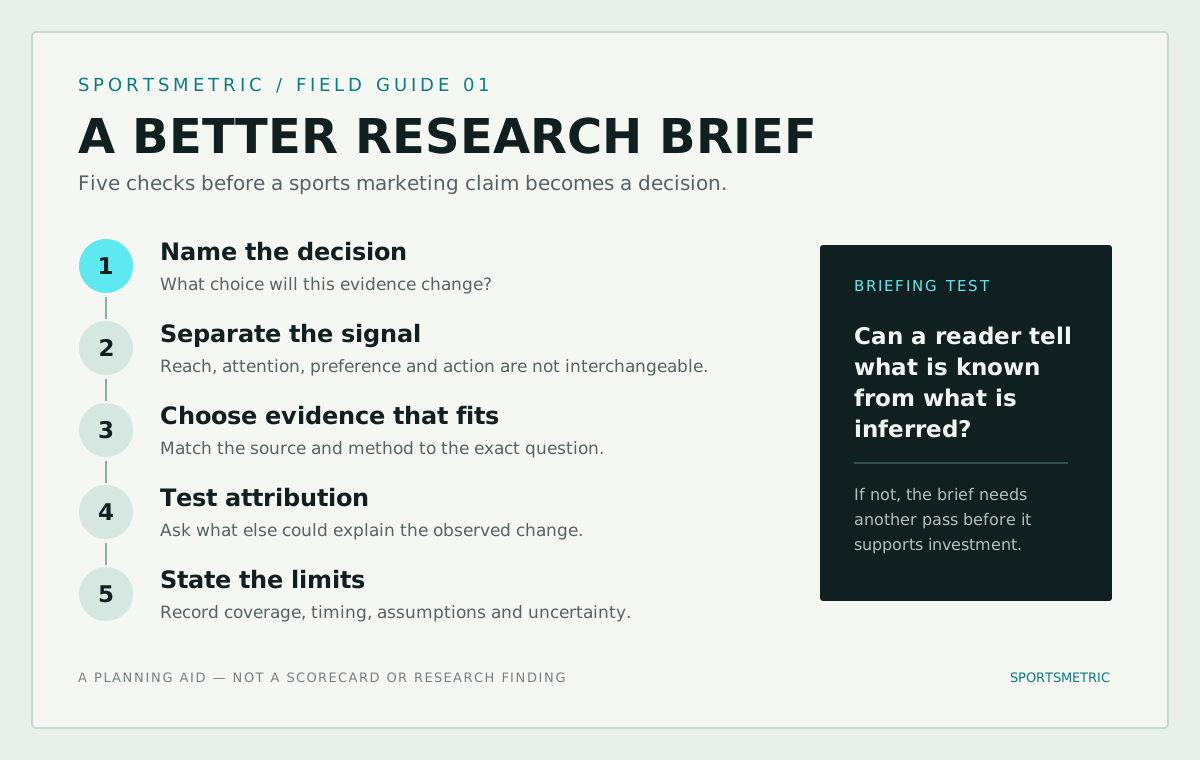
Turn a broad ambition into a research question
“We should get into women’s basketball” is a direction, not a strategy. A better brief identifies a target customer, a market and a desired change: for example, whether a basketball partnership is a plausible way to introduce an existing product to a particular community. This is an illustrative planning question, not a claimed campaign.
Specify constraints early: market, timing, resources, content permissions and the people who will make the decision. Do not treat missing audience geography or demographics as evidence that an account matches the intended customer.
Build a short list with reasons and counterarguments
Inspect audience scale alongside recent content, growth history, sporting context and documented brand activity. Compare equivalent time windows, preserve missing values and look at the starting follower count behind a large growth percentage.
A useful short list includes an argument against each candidate as well as an argument for them. An account may be growing quickly but have limited market evidence, an overlapping brand relationship or insufficient historical coverage. Those uncertainties should travel with the recommendation.
- Define the target audience and objective.
- Record why each candidate is relevant.
- Verify identities and primary evidence.
- Check competing events and measurement gaps.
- Agree the measurement plan before the activation.
Choose the form of participation
Sponsorship rights, creator content, paid advertising and community programmes solve different problems. The IOC’s TOP description is a useful reminder that rights are specific entitlements; buying an entitlement does not automatically produce a compelling activation.
Describe the role of the brand in terms a fan would recognise: useful information, access, a product experience or support for a community. Label any proposed activation as a proposal rather than presenting it as an existing case study.
Set a review rule before spending
AMEC recommends choosing measures that correspond to the communication objective rather than confusing output with outcome. Define which indicators will be monitored, who owns the data and what would justify continuing, changing or stopping the activity.
The recommendation should remain usable when a data field is absent. “Needs verification before outreach” is more useful than a precise-looking fit score made from unsupported assumptions.