Agree the definition before calculating
For this guide, incremental contribution means additional revenue attributable to the activity after the relevant variable costs, but before the sponsorship investment being assessed. Define costs carefully so they are not deducted twice. A finance team may use a different convention; name it explicitly rather than comparing incompatible ratios.
Total investment may include rights, production, distribution, agency and measurement costs, depending on the agreed scope. A public announcement rarely discloses all of these. If costs or incremental contribution are unknown, financial ROI is unavailable—not zero and not an engagement-derived substitute.
The difficult question: what would have happened anyway?
An increase after an announcement is not automatically caused by it. Sporting performance, other campaigns, seasonality, distribution and competitor activity may also change outcomes. A defensible evaluation needs a credible estimate of the outcome without the activity.
Google’s user-based Conversion Lift documentation demonstrates the principle for eligible ad campaigns by comparing a treatment group with a group held back from ads. Sponsorship evaluations may require different designs and specialist input; that particular ad method is not automatically applicable to every partnership.
What evidence is needed?
Plan access and responsibilities before the campaign. Business data may be private, incomplete or affected by selection bias. Be explicit about uncertainty and the period over which an effect is being assessed.
- An agreed financial objective and cost scope.
- Reliable records of delivery and timing.
- Relevant business outcomes and contribution assumptions.
- A credible comparison or evaluation design.
- Controls for other plausible explanations.
- Uncertainty, missing data and a stated review period.
What can you report when ROI cannot be established?
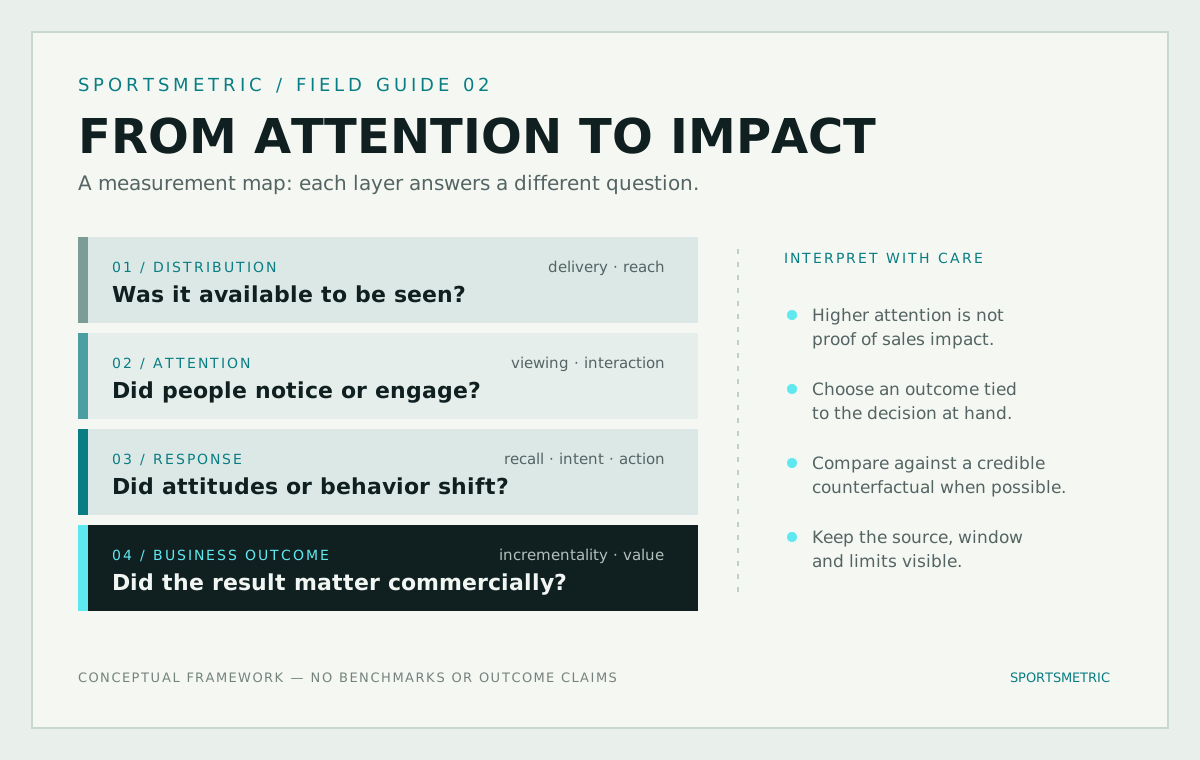
Report the evidence you do have at its proper level: delivered activity, recorded audience response, awareness research or a clearly bounded observational comparison. AMEC explicitly distinguishes evaluation stages and warns against using outputs to stand in for outcomes.
A recommendation to test a promising audience is a legitimate result of research. It should not be relabeled as proven financial return. Sportsmetric’s social and event context can support investigation, but it does not provide the private costs, sales evidence or experimental design needed to calculate causal sponsorship ROI.