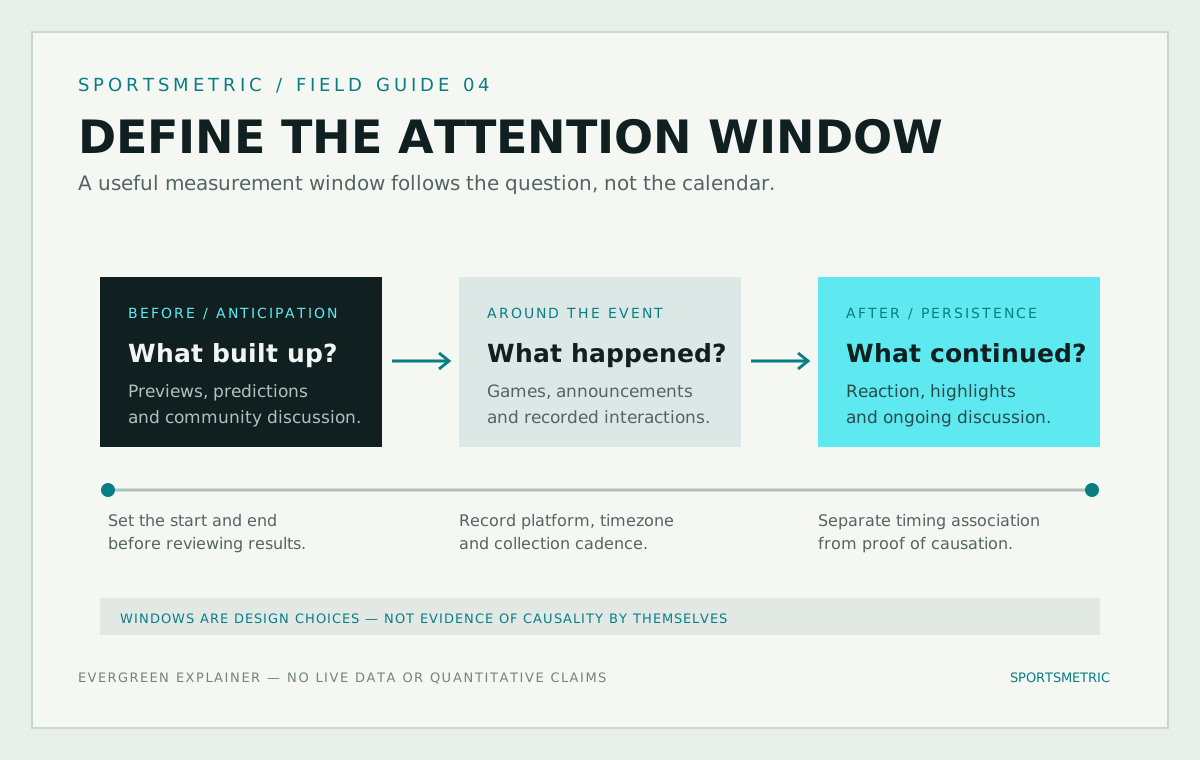
Why look before and after the event?
A tournament final can attract previews, predictions and creator discussion before play begins. Reactions, highlights and analysis may continue afterward. Looking only at match day can miss both anticipation and persistence. This is a conceptual example, not a finding about any particular player’s final.
An injury or comeback can also generate interest, support or debate. It should not automatically be interpreted as a decline in marketing value, or as a commercial opportunity. Inspect evidence and context rather than assigning a positive or negative label from the event type.
How should the dates be selected?
Define the window before interpreting the result, using the question and available coverage. Record its start, end, event date, platform and time zone. A long tournament and a short announcement may need different periods. There is no universal window that suits every sport or activity.
Keep a researcher-selected investigation window distinct from a source-defined news coverage range or a platform attribution setting. They may overlap, but they describe different things. Changing the dates can change the comparison and should be disclosed.
- State the event and research question.
- Record the baseline and investigation dates.
- Inspect anticipation, event activity and subsequent discussion.
- List other events in the same period.
- Check source dates and missing observations.
- Describe the result as observational unless causal evidence exists.
What makes a fair comparison?
Compare the same account and platform over explicitly defined periods. If comparing average daily changes, use comparable day counts and disclose missing observations. Do not treat an unobserved day as zero or use a news peak multiple as a follower-growth percentage.
Follower changes, published stories and post interactions are different signals. Their timing can suggest a useful question, but overlapping activity means the timeline alone cannot isolate which event, if any, explains a change.
What can an attention window tell a marketer?
It can help show when a topic appeared, which evidence accompanied it and whether recorded attention persisted within the available period. It cannot establish audience sentiment, purchase intent, campaign exposure or incremental sales without the relevant additional evidence.
AMEC’s separation of evaluation stages and Google’s treatment-versus-control explanation of lift provide useful guardrails: observed response is not the same as demonstrated business impact. Use an attention window to investigate, not to manufacture a causal conclusion.