Advertising is a distribution method, not the whole strategy
A brand can pay to distribute creative around sports content without buying a league sponsorship. A sponsor can also buy media to distribute an activation. The agreement and the distribution plan determine what the brand may say and where it may appear; sport-related creative alone does not prove an official association.
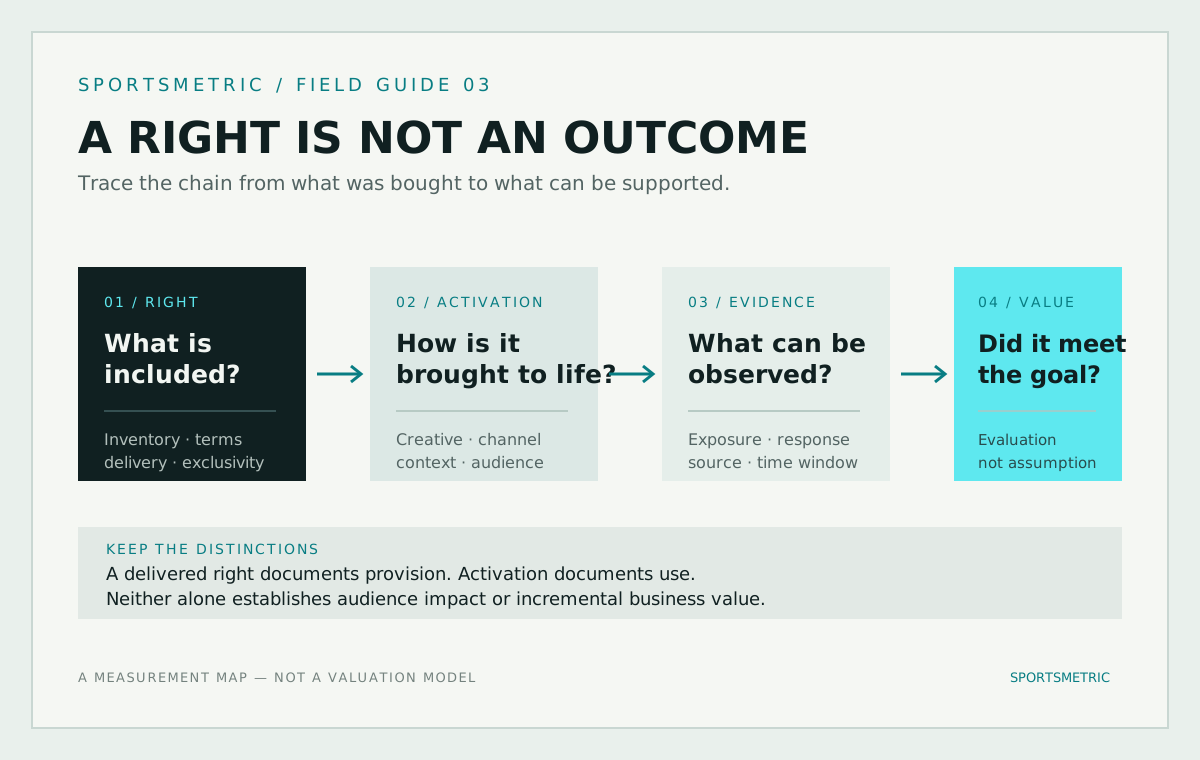
The IOC’s TOP programme helps explain the distinction: it grants defined marketing rights to partners. Those entitlements should not be confused with the impressions or interactions produced by an individual ad placement.
Sports marketing versus sports advertising
Sports marketing asks the broader questions: which community matters, why the brand belongs, what proposition is useful and how success will be evaluated. Sports advertising asks how paid messages will reach a selected audience and perform against a campaign objective.
For research, keep the scopes comparable. Interest in the broad phrase “sports advertising” does not establish demand for an analytics platform, and a high-volume educational query does not imply high commercial intent. A product page and a definition page should answer different needs.
What should an advertising measurement brief ask?
Paid delivery data usually needs to come from the advertiser, publisher or measurement provider. Public athlete posts do not reveal complete media spend, deduplicated exposure or conversions. Social activity around a campaign can provide context but cannot replace its delivery records.
Google distinguishes standard attributed conversions from incremental conversions measured through Conversion Lift. That distinction matters: credit assigned by a reporting rule is not automatically evidence that the advertisement caused additional purchases.
- What is the objective and intended audience?
- Which paid channels and placements are included?
- Who supplies spend, delivery and conversion records?
- Which attribution rules and windows apply?
- Is the result attributed, observational or experimental?
- What uncertainty or missing coverage remains?
Where does Sportsmetric fit?
Sportsmetric supports research into available sports audiences, activity, content examples and recorded relationships. It is not an ad-buying platform and does not claim complete paid-ad monitoring, broadcast logo valuation or incremental advertising return.
Use public evidence to formulate a hypothesis and prepare a better brief. Use the relevant campaign systems and evaluation methods to assess paid delivery and business impact.