
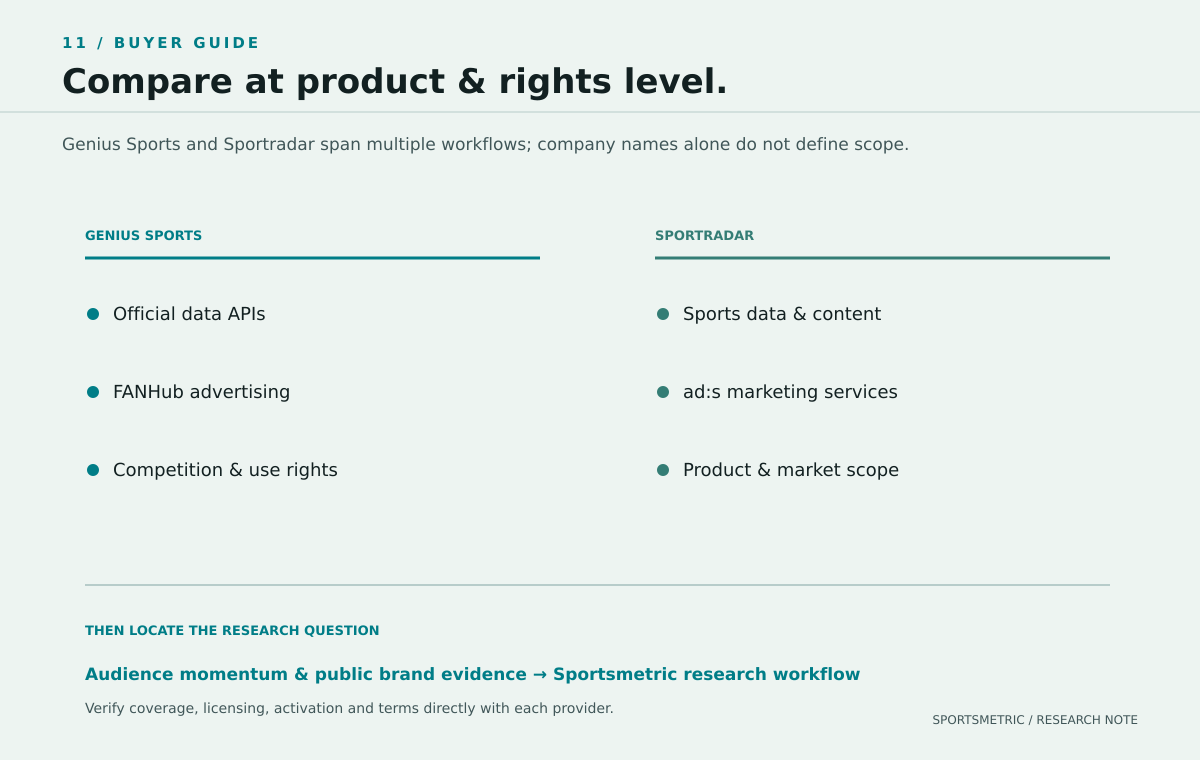
At a glance
| Buying question | Genius Sports | Sportradar |
|---|---|---|
| Sports data and content | Official live and historical sports data APIs; verify the exact competition and permitted use | Sports data and content within a broader sports technology portfolio; verify the exact competition and permitted use |
| Marketing and activation | FANHub combines fan-focused programmatic and social buying, activation and creative personalization | ad:s advertises sports-moments marketing, sponsorship acquisition and activation |
| Betting-related requirements | Investigate the relevant betting product and rights agreement, separately from a brand campaign brief | Investigate the relevant betting and gaming product and rights agreement, separately from a brand campaign brief |
| Team or league evaluation | Ask about data collection, distribution, media products and your particular rights obligations | Ask about data, audiovisual, coaching/scouting and marketing products relevant to your brief |
| What cannot be inferred | Company-wide descriptions do not establish a price, universal coverage or a guaranteed outcome | Company-wide descriptions do not establish a price, universal coverage or a guaranteed outcome |
What is the main difference between Genius Sports and Sportradar?
At company level, their portfolios overlap enough that a single feature-based winner would be misleading. Both work with sports data and fan-facing experiences, and both have marketing offerings. The practical differences emerge at product and contract level: which competition is covered, what data is licensed, how it can be used, how delivery works and which services are included.
Genius Sports’ official data API page describes live and historical feeds for broadcasts, websites, apps and analytical products. Sportradar’s site describes solutions spanning betting and gaming, media and technology, and rights holders. Those descriptions establish areas to investigate, not that either provider can supply every event or use case. This guide compares procurement decisions, not company valuations, share prices or investment returns.
Which is relevant to sports advertising and fan activation?
Both deserve consideration. Genius Sports describes FANHub as an omnichannel platform combining programmatic and social buying, audience activation and creative personalization. A marketing team evaluating paid fan acquisition or sports-specific media execution should investigate that product directly rather than dismiss Genius as only a game-statistics vendor.
Sportradar’s ad:s page describes sports-moments marketing, sponsorship acquisition and activation. It also includes an engagement tool connecting publisher content with betting opportunities. Separate the general brand brief from betting-specific modules: permitted markets, brand suitability, audience controls and deployment requirements matter. Do not assume every ad:s feature is appropriate to every advertiser.
For either provider, ask for a demonstration using your target audience and campaign geography. Require clarity on the distinction between modeled or identified fans, reachable advertising audiences, delivered impressions and business outcomes. Those are not interchangeable measures of fandom.
How should teams and leagues compare sports-data providers?
Start with a written coverage and rights checklist. Name the competition, season, event types, fields, historical depth and expected delivery latency. Ask which rights allow internal analysis, redistribution, broadcast graphics, public display or betting use. Coverage for one purpose does not establish permission for another.
Then evaluate operations: identifiers, update and correction policies, integration support, delivery guarantees and what happens during outages. Run an agreed sample against the actual fixtures your team needs. A vendor’s overall scale cannot replace contract-level verification of your sport, market and application.
- Which exact competitions, seasons and data fields are included?
- What uses, territories, retention and redistribution are licensed?
- How are player identities, corrections and historical changes handled?
- Which delivery commitments, onboarding services and total costs apply?
Where does Sportsmetric fit alongside Genius Sports and Sportradar?
Sportsmetric is relevant when the question is which athletes, teams or creators merit marketing attention, how their recorded social audiences are changing, and what public brand activity supports further investigation. Its research workflows combine available profile observations, post examples and sports-moment context. That is a different starting point from buying a data feed or executing an advertising campaign.
For example, a brand considering women’s basketball partnerships can begin with Sportsmetric’s WNBA research and Sponsorship Tracker, inspect observation dates and review the underlying announcements or posts. A product appearance in a post is not automatically a paid contract; a public announcement does not disclose every commercial term.
Sportsmetric is not presented here as an official live-game feed, a sportsbook platform, an ad-buying system or a replacement for either company’s contracted services. Observed social activity does not establish verified fan identity, brand affinity, incremental sales or causal campaign impact. It can support the research stage of a marketing decision, not answer every measurement question.
Which should a CMO put on the shortlist?
If the brief is to execute sports advertising, investigate FANHub and the relevant ad:s services. If it is to license live data or build a sports-content experience, evaluate each provider’s exact data product and rights package. If it is to research audience momentum and source-backed brand activity before selecting partners, investigate Sportsmetric.
These choices are not necessarily exclusive. A brand might research candidates in one product and activate a paid campaign through another; a league might procure data infrastructure separately from its commercial research tools. Keep the handoff explicit: what was observed, what decision it supports and what additional evidence is required.
How was this guide researched?
Sportsmetric publishes this guide and includes its own product. Public vendor pages were reviewed on October 30, 2026; this is not an independent hands-on benchmark. Descriptions of third-party capabilities summarize advertised offerings, not verified service levels, measured accuracy or an endorsement by those vendors. Sources are linked below.
Products, rights and coverage change. Confirm the specific sport, competition, market, platform, historical period, license, integration and commercial terms directly with each provider. We do not assign invented scores, quote unverified prices or infer that an unmentioned feature is absent. Sportsmetric’s available observations vary by profile and date; missing evidence remains unavailable.