
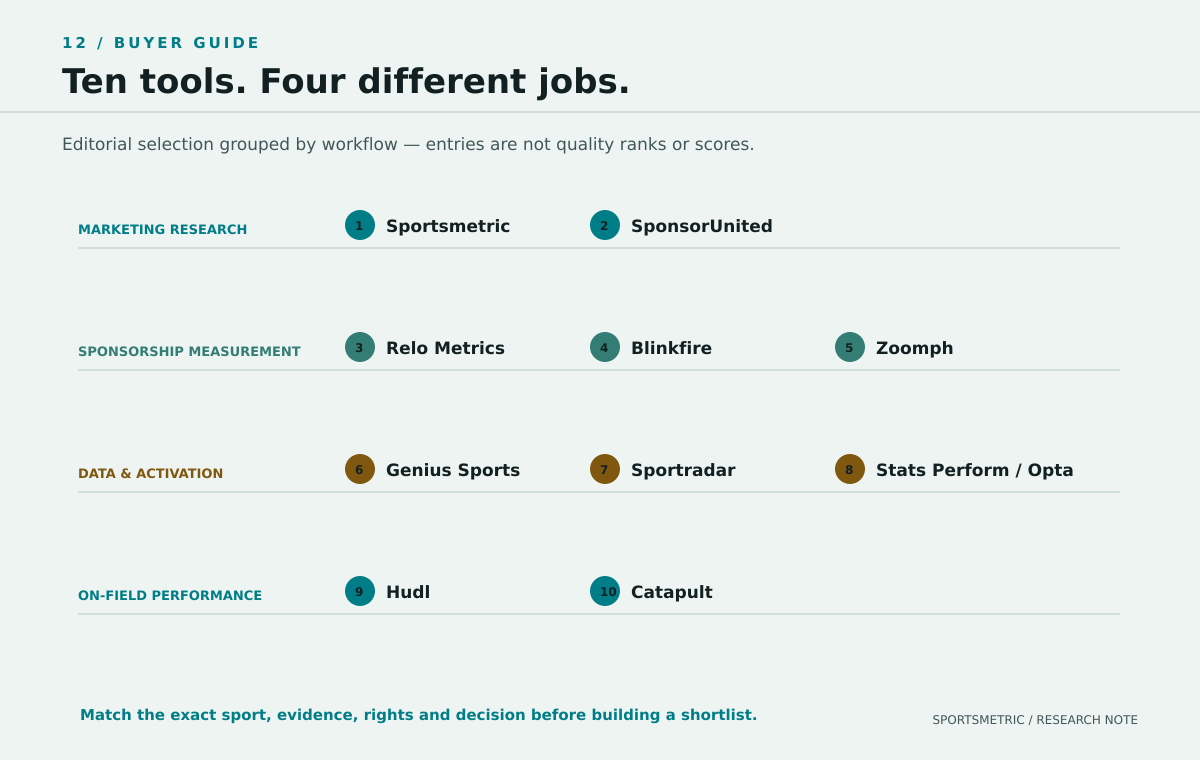
At a glance
| Tool | Workflow to investigate | Buyer check |
|---|---|---|
| 1. Sportsmetric | Social audience, sports attention and brand-activity research | Check exact profile coverage, dates and source evidence |
| 2. SponsorUnited | Sponsorship intelligence, opportunities and commercial benchmarking | Inspect relationship definitions and benchmark comparability |
| 3. Relo Metrics | Sponsorship exposure across broadcast, streaming and social | Confirm asset coverage and exposure-to-outcome methodology |
| 4. Blinkfire | Computer-vision sponsorship detection and media analysis | Review detection definitions and valuation assumptions |
| 5. Zoomph | Sponsorship measurement and consolidated reporting | Check platform coverage, audience metrics and valuation methods |
| 6. Genius Sports FANHub | Sports advertising and audience activation | Confirm audience access, inventory, markets and campaign scope |
| 7. Sportradar | Sports data, media and ad:s marketing services | Specify the product, rights and activation requirements |
| 8. Stats Perform / Opta | Sports data, analysis and content experiences | Confirm competition coverage and licensed uses |
| 9. Hudl | Video analysis, coaching and scouting | Match the product and capture workflow to the team |
| 10. Catapult | Athlete monitoring and performance workflows | Evaluate devices, protocols, integrations and implementation |
How were these ten sports analytics tools selected?
We selected tools with public product descriptions relevant to at least one of four decisions: research sports audiences and partners; measure sponsorship visibility; activate audiences or build data-led experiences; analyze on-field performance. The list deliberately spans those categories so teams, leagues and brands can avoid comparing unlike products.
Selection does not mean each platform serves every buyer equally. The sequence groups related workflows rather than awarding scores. Sportsmetric appears in its own publisher’s guide, not as an independently tested winner. Pricing is not ranked because comparable, verified quotes were not established. Use the linked primary sources and an actual demonstration to build your procurement shortlist.
1. Sportsmetric — social audience and brand-activity research
Investigate Sportsmetric when a marketer needs to research tracked athletes, teams or creators using dated audience observations, available post examples and sports context. Relevant workflows include finding profiles with recent momentum, comparing candidates and inspecting evidence behind recorded brand activity. The free Sponsorship Tracker and WNBA research content provide public starting points.
Check coverage for your exact profiles, platforms and observation period before relying on a comparison. Social followers are not unique fans; an event near a growth change is not proof of cause. Sportsmetric is not a coaching platform, a verified sponsorship-price database, a paid-media buying system or a guarantee of commercial ROI.
2. SponsorUnited — sponsorship intelligence and commercial research
SponsorUnited describes tools for brands, rights holders, agencies and media companies, including sponsorship opportunities, pricing benchmarks and activation examples. Investigate it when the commercial team needs market context for partnership prospecting, proposals or negotiations rather than only athlete audience movement.
Ask how a relationship is verified, when it was observed and which rights and deliverables underlie a benchmark. Comparing two sponsorship prices without comparable inventory and market context can mislead. Its advertised commercial intelligence is not equivalent to Sportsmetric’s post-backed brand observations.
3. Relo Metrics — cross-channel sponsorship exposure measurement
Relo Metrics describes sponsorship measurement across broadcast, streaming and social media, alongside datasets and integrations intended to connect exposure with other outcomes. It is relevant to brand, team and league teams trying to understand where sponsored assets appeared and how a portfolio performed under an agreed measurement method.
Request a demonstration with your actual placements, channels and reporting period. Ask what the exposure metric counts, how valuations are calculated and what additional first-party or partner data supports outcome analysis. Measured visibility and modeled value are not automatically incremental sales or causal return.
4. Blinkfire — computer-vision sponsorship detection
Blinkfire describes AI and computer-vision technology for identifying sponsorship elements across media formats and platforms. Investigate it for workflows involving logos, branded assets, sponsorship exposure and media analysis rather than treating every visible product as a confirmed commercial relationship.
Ask which surfaces, sports and formats are covered, how detections are checked and which assumptions underpin valuation. A detected sponsor element, an exposure estimate and a documented agreement are different records. Establish which one the report needs before comparing suppliers.
5. Zoomph — sponsorship analytics and reporting
Zoomph describes a reporting platform combining logo detection, broadcast analytics and social media valuation for partnership measurement. It is relevant when a team, league, brand or agency needs to consolidate measured sponsorship activity across supported channels.
Confirm the exact social platforms, broadcast scope, audience definitions and reporting access included in the proposed service. Request an explanation of valuation and aggregation rules, especially when the same audience can encounter an asset repeatedly. Reporting exposure does not, by itself, establish improved brand affinity.
6. Genius Sports FANHub — sports advertising and activation
FANHub advertises fan-focused programmatic and social buying, audience activation and creative personalization. Investigate it when the marketing brief concerns reaching sports audiences through paid media and sports-specific creative—not merely reading a dashboard of athlete followers.
Ask about eligible audiences, activation markets, available inventory, reporting definitions and the exact campaign services contracted. Genius Sports also has data products; do not assume a FANHub advertising agreement includes every data feed or that a data agreement includes media execution.
7. Sportradar — sports data, media and marketing services
Sportradar’s portfolio spans sports data, media, betting-related technology and rights-holder services. Its ad:s offering describes sports-moments marketing and sponsorship acquisition and activation. It belongs on this list because a league’s infrastructure brief and a brand’s activation brief may both be relevant, but to different products.
Specify the product and licensed uses before requesting a quote. Some advertised engagement services concern betting opportunities and require separate suitability and market checks. A general brand campaign should not inherit betting-specific assumptions, and broad corporate coverage is not proof of a particular competition’s availability.
8. Stats Perform / Opta — sports data and analytical content
Stats Perform’s Opta portfolio includes sports data, media tools, fan engagement and performance solutions. Investigate it when the organization needs data-led match analysis, sports storytelling or a licensed content experience. It is not simply another way to measure an athlete’s social popularity.
Confirm the relevant competition, fields, historical coverage, update process and content or redistribution rights. A data product suitable for an internal analytical workflow may have different terms from a public website, broadcast or commercial application.
9. Hudl — video, coaching and scouting workflows
Hudl’s product catalog covers video analysis, automated capture, scouting and recruiting, with different products for different sporting environments. Investigate it when coaches and analysts need to capture, review and learn from game footage or support talent evaluation.
Choose the specific product and sport rather than buying on the company name alone. Check equipment, tagging, analyst workflows and access permissions. Hudl also offers fan-facing products, but performance video analysis is not a substitute for research into sponsor relationships or changing social audiences.
10. Catapult — athlete monitoring and performance analysis
Catapult describes athlete monitoring and coaching systems, including sensor-based performance observations and integrations with video analysis. Investigate it when performance staff need physical monitoring and training context rather than public marketing-audience research.
Evaluate the measurement protocol, devices, implementation support and fit with staff workflows. Establish who can access athlete information and how it will be governed. Product positioning around performance or injury-risk management should not be interpreted as a guaranteed prevention or medical outcome.
Which sports analytics tool should teams, leagues and brands choose?
For a brand or CMO, start with the decision: research possible partners, measure existing sponsor visibility or execute paid media. Sportsmetric and SponsorUnited address research from different evidence bases; Relo Metrics, Blinkfire and Zoomph address sponsorship measurement; FANHub and relevant Sportradar services address activation. These categories overlap, so demonstrate the actual workflow rather than assuming exclusivity.
For a league, separate data rights and distribution from commercial audience research and sponsor reporting. For a team, separate the performance department’s video and monitoring needs from the marketing department’s audience and partnership questions. Stats Perform, Genius Sports and Sportradar warrant product-specific data evaluation; Hudl and Catapult warrant performance-workflow evaluation.
Use the same brief for every relevant supplier: exact sport and profiles, required period, source lineage, delivery method, license, integrations, privacy requirements and full implementation cost. Ask each to show one real record end to end, including an unavailable or corrected observation. The ability to explain the limits is part of a useful demonstration.
How was this guide researched?
Sportsmetric publishes this guide and includes its own product. Public vendor pages were reviewed on October 30, 2026; this is not an independent hands-on benchmark. Descriptions of third-party capabilities summarize advertised offerings, not verified service levels, measured accuracy or an endorsement by those vendors. Sources are linked below.
Products, rights and coverage change. Confirm the specific sport, competition, market, platform, historical period, license, integration and commercial terms directly with each provider. We do not assign invented scores, quote unverified prices or infer that an unmentioned feature is absent. Sportsmetric’s available observations vary by profile and date; missing evidence remains unavailable.
Continue your research
Sources and further reading
- Genius Sports: FANHub advertising platform
- Genius Sports: official sports data APIs
- Sportradar: sports technology and product portfolio
- Sportradar: ad:s marketing services and sponsorship
- Hudl: team performance, capture and scouting products
- Catapult: athlete monitoring systems
- Stats Perform: Opta data, media and performance solutions
- Relo Metrics: sponsorship measurement and exposure data
- Blinkfire: computer-vision sponsorship technology
- Zoomph: sponsorship measurement and reporting
- SponsorUnited: sponsorship intelligence for brands and rights holders